Thursday, 17 May 2012

Berat - the town of one thousand and one windows

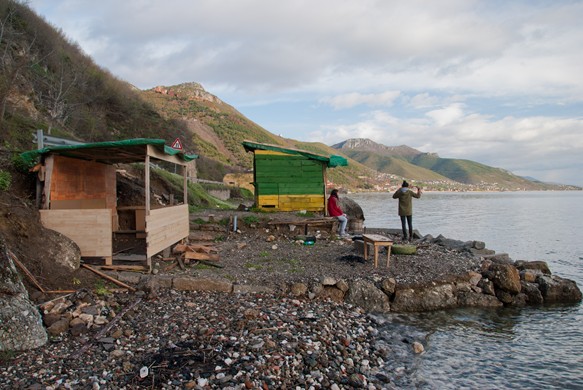
This time I went with my friends to Albania to visit Gjirokaster, Butrint and Berat. However, the weather thwarted our plans and we limited just to Berat, with a night spent in Pogradec. Before the dusk we managed to find a wooden, abandoned shed, where we put a tent for better protection. After a hard, rainy night we took advantage of better conditions and hitchhiked to Berat, previously consuming a coffee on the egde of multi-funcional-car-funeral-shop. The trip was very tiring and bumpy (roads in Albania are horrible), but most of the drivers were ready to compensate this fact with a beer or hot dinner.






Berat - an amazing city. Is the second (after Gjirokaster) city-museum, called "the city of one thousand and one windows"). Situated on the hill, with a labirynth of narrow streets and beautiful architecture is a bit similar to Ohrid, but without the lake. The city located at the foot of Tomori massif, can boast of the most preserved old town from the ottoman times in all Albania.


Wednesday, 4 April 2012

The pyramid of Enver Hoxha in Tirana

A concrete-glass pyramid, standing in the centre of Tirana - the legend of the city, the meeting spot of Albanian youth, the centre of artistic expression, and in the past the museum of Enver Hoxha, might soon pass away. In July last year, 72 of 72 albanian deputees decided to demolish it for the new building of parliament. The pyramid of Hoxha was erected in 1987, two years after dictator's death for gigantic sum of 700 mln dollars...the project designed by his daughter - Pranvera. Uncle Enver planned to create there museum of himself. 
When the communism in Albania collapsed, the pyramid was transformed to the cultural centre, then a nigh club, cafe and studio of a local television. Albanian journalists enjoyed here macchiatos and cheap albanian cigarettes while discussing the issues of the day.
Over time, the masterpiece of socialistic architecture became an attraction for kids, who discovered they could climb up the building's sloping walls and slide down to the ground. Obviously, in Tirana, the best option to arrange a meeting is "under the pyramide". The building is perfect also for graffiti-painters who could express their artistic skills (or lack of them), presentation of political views and expressing feelings of course. In 2007, President G. W. Bush delivered his speech here, becoming the first US leader who visited Albania.
In spite of placing the pyramid on a cultural heritage list in 2003, the government decided to get rid of a communistic symbol, not considering the 79% public opinion's objection. If the new parliament is built here, it is supposed to open for business in November this year – in time to celebrate the 100th anniversary of Albania’s independence from under 5-centuries-long Turks occupation.


Wednesday, 21 March 2012

Zastava 750 - the legend of Yugoslavian roads


Zastava 750, 322-centimeter miracle on wheels, the legend of yugoslavian roads, or just "Fića". The license version of the vehicle Fiat 600D (seicento), called “ladybird”, was in production from 1955 to 1985 in Yugoslavian factory Zavodi Crvena Zastava (Red Banner Factories) in Kragujevac (today Serbia). Real rarity amongst vintage-cars collectors, the hero of many yugo movies and the object of interests of moto fans and not only. 
Zastava 750, commonly known as "Fića" (Фићa) or "Fićo" (Фићo) in Serbian, Croatian and Bosnian, "Fičo" and "Fičko" in Slovenia, and "Fikjo" (Фиќо) in Macedonian.
Starting from 60’s last century, "Fića" became very popular not only in the Balkans but also in Spain, released as SEAT 600 and in Argentina, where was called – Fitito.
The maximum speed of the vehicle, depending on the version, oscillate between 95 – 105 km/h (at least you can try to do this without damaging the engine). “Fikjo” gained popularity especially in the last years of production, because of low level of fuel consumption and very cheap price on the second hand market. Zastava 750 became the symbol of yugo-nostalgia and the legend of Yugoslavian motorization. 
When in the beginning of 90’s the war on the Balkans broke, the factory of Zastava switched over to weapon production, and the license of the 750 model was sold to Turkey, where has been produced for few years more.


Saturday, 10 March 2012

The memorial-mystery in Kavadarci

Beautifully located, concrete monument in Kavadarci, called Kosturnica is undoubtedly one of the worth to visit places  in this town. The memorial is situated on the top of the 300m hill, on the edge of the city park. Designed by Peter Milichkovski -  architect from Skopje and unveiled in September 1976. As many monuments like this, “concretes” usually commemorate WW II victims and heroes fighting for liberty of Yugoslavia from the claws of nazi invader. I was climbing up having exactly this image in my head. To my surprise, there is nowhere clearly written to whose honour the memorial is built, only 20 marble plaques with 328 names of killed. Apparently it’s so obvious that authors of the monument forgot to mention about it. Another puzzle to figure out is the form and shape of the contruction. Any connotations? Supposedly refers to traditional, Macedonian house from Ohrid. The lower part is closed into an internal yard, which leads outside to the “amphitheatre”. Well, let you interpret this as you like…inside spiral stairs lead us to the top of the memorial, from where we can see really nice view.